
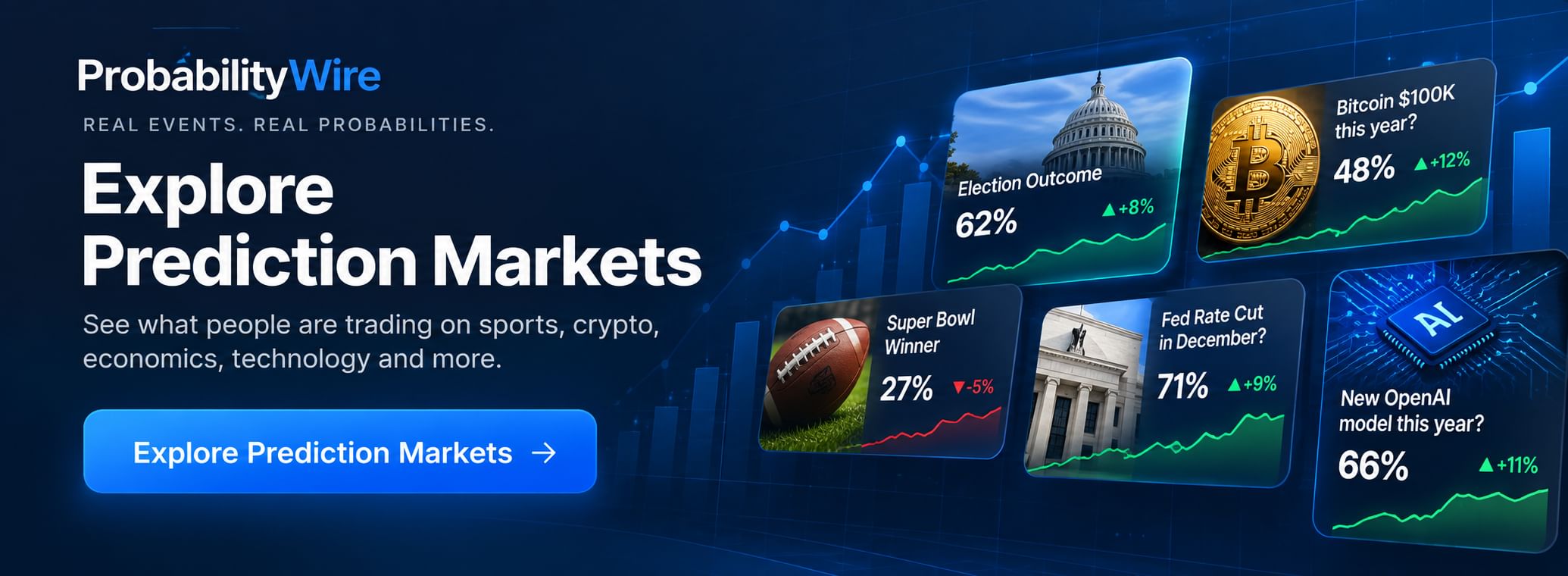
Prediction Markets vs Sports Betting: What’s the Difference?
Prediction markets and sports betting can look similar on the surface because both involve putting money behind an outcome. The core difference is what you are “buying.”
In a prediction market, you typically trade event contracts whose price moves as people buy and sell. That price can be read as a market-implied probability (not a guarantee) that updates as new information arrives. In sports betting, you place a wager against a sportsbook’s odds, and your bet does not keep trading in an open market the same way.
That distinction - trading a market price versus betting into bookmaker odds - explains most of the practical differences in how these products work, what they’re used for, and what you should watch for.
What you’re actually doing: “Trading probabilities” vs “placing a wager”
With sports betting, you are usually choosing a side (team, total, prop) and accepting a set of odds offered by the sportsbook at that moment. You can often cash out early if the book offers it, but your original wager is not designed to be continuously bought and sold between users.
With prediction markets, participation is often closer to trading:
- You can enter and exit by buying and selling contracts as prices move.
- Your profit or loss can depend not only on being right at the end, but also on how the market reprices along the way.
- The “odds” are effectively the current market price , shaped by participants.
This is why prediction markets are frequently discussed alongside probabilities, forecasting, and “information aggregation,” while sports betting is typically framed as wagering and line shopping.
Why prices in prediction markets look like probabilities
Many event contracts are structured so that a correct outcome settles at $1.00 (or 100) and an incorrect outcome settles at $0.00 (or 0). If a contract is trading at $0.63, people often interpret that as roughly a 63 percent market-implied probability.
That probability is not an official forecast. It’s a snapshot of what traders are willing to pay right now, under platform rules, fees, and the available liquidity.
Sports betting odds also imply probabilities, but they include the sportsbook’s margin (often called the vig). Prediction-market prices can also deviate from “true” probabilities because of fees, trading frictions, uneven participation, or the fact that some traders are hedging rather than “predicting.”
YES and NO contracts: the most common prediction-market building blocks
A lot of prediction markets use YES and NO sides for a single question, such as “Will Team A win on Saturday?” or “Will the central bank raise rates at the next meeting?”
- A YES contract pays out if the event happens.
- A NO contract pays out if the event does not happen.
Depending on the platform design, you might buy YES, buy NO, or create positions that mimic one side by selling the other. The key is that these contracts are typically tradeable, so you may be able to close the position before settlement by selling to another participant (if liquidity exists).
Sportsbook odds: fixed pricing with a built-in margin
Sportsbooks publish odds and adjust them to balance risk, respond to new information (injuries, weather, lineups), and reflect betting demand. The sportsbook sets the rules, decides what markets to offer, and embeds a margin so that the book can earn revenue over time.
Two practical implications:
- You are not trading with other bettors directly in most standard sportsbook products. You are betting into the sportsbook’s price.
- Line shopping matters because different sportsbooks can post different odds for the same game, and small differences can change expected value.
Prediction markets can also charge fees, but the pricing dynamic is generally driven more by trader-to-trader activity than by a bookmaker setting a line.
Market mechanics that feel more like a trading app than a sportsbook
Prediction markets often borrow terminology from financial trading. Understanding a few basic mechanics helps clarify why they behave differently than betting.
Liquidity and trading volume: Liquidity is simply how easy it is to buy or sell without moving the price much. In thin markets, a modest order can shift the price, which can make “probabilities” jump around for reasons that have nothing to do with new information.
Market orders and limit orders: Some platforms let you place:
- Market orders , which execute immediately at the best available price (useful, but can be costly in thin markets).
- Limit orders , where you specify the maximum you’ll pay (or minimum you’ll accept). These can help control entry price and slippage.
Sports betting generally doesn’t work this way. You accept offered odds (or you don’t), and there is no order book for you to post “I’ll take this price if it appears.”
Spreads and slippage: Prediction markets can have bid-ask spreads, especially when participation is low. That spread is a real cost to frequent trading and can make short-term in-and-out strategies harder.
How settlement works: “Resolution rules” vs “grading the bet”
Both systems eventually need a final answer.
In sports betting, grading is tied to house rules (for example, how overtime counts, what happens if a game is postponed, or how player props are handled after stat corrections). These rules vary by sportsbook.
In prediction markets, the platform publishes resolution criteria for each market. Good resolution language specifies:
- The exact question being answered
- The authoritative data source (league box score, official announcement, government release, and so on)
- What happens if the source is delayed, revised, or disputed
Because prediction markets can cover non-sports events - economics, politics, technology milestones, crypto-related questions - clear resolution criteria are especially important. If the resolution terms are vague, traders can end up debating semantics instead of forecasting.
What you can bet on vs what you can trade: market selection is fundamentally different
Sportsbooks focus on sports (game lines, totals, futures, props). Prediction markets can include sports, but they are often broader:
- Elections and governance outcomes
- Economic releases and interest-rate decisions
- Company and technology events (product launches, approvals, milestones)
- Crypto ecosystem events (protocol upgrades, exchange-traded product decisions, on-chain metrics, depending on what a platform lists)
If you’re researching this space, ProbabilityWire’s coverage of prediction markets and event contracts is often where the terminology overlaps most with “trading probabilities,” rather than traditional betting language.
Regulation: why “sports betting” and “event contracts” live in different buckets
Sports betting in the United States is regulated at the state level, and legal availability depends heavily on where you are physically located. Sportsbooks operate under state licensing regimes, and states set rules around permitted markets, consumer protections, taxation, and enforcement.
Prediction markets and event contracts can fall under different regulatory frameworks depending on product structure and jurisdiction. Some offerings resemble derivatives or commodities-style contracts, and rules can be different from sports wagering. Availability can change quickly due to legal interpretations, court decisions, or regulator guidance, so it’s smart to treat “where can I use this?” as a moving target rather than a permanent feature.
If a platform is unclear about its legal basis or eligibility restrictions, that’s not a small detail - it’s a primary risk factor.
Fees, costs, and the less-obvious ways you pay
Sports betting costs are usually “priced in” through the odds (the vig) and sometimes through limits, restricted markets, or reduced payouts compared to “fair odds.”
Prediction markets may charge:
- Trading fees
- Settlement or redemption fees
- Spreads and slippage (an indirect cost)
- Funding-related costs depending on payment rails used
The important comparison is not “which is cheaper” in the abstract, but how the cost shows up. A platform with low explicit fees can still be expensive to trade if liquidity is thin and spreads are wide.
Deposits, withdrawals, and what “custody” can mean
Sportsbooks typically hold customer balances in sportsbook accounts and support common payment methods offered in regulated wagering.
Prediction-market platforms vary widely. Some use traditional payment methods, while others rely on crypto rails or stablecoins. The user experience can range from “simple app onboarding” to “bring your own wallet,” and the practical tradeoffs include speed, reversibility, fees, and user responsibility for security.
Because implementations differ so much, it’s worth checking a platform’s published help docs rather than assuming “it works like a sportsbook.”
Prediction markets vs polls: why they can disagree
People often compare prediction-market prices to polling numbers, but they are not measuring the same thing.
- Polls measure survey responses at a point in time, with sampling methods, likely-voter screens, and margins of error.
- Prediction markets reflect tradable prices influenced by beliefs, hedging, risk tolerance, fees, and who is actually participating.
A poll can move public perception, which can move a market price. But a market can also move on non-poll information (fundraising reports, legal decisions, injury news, or macro data). When they disagree, it doesn’t automatically mean one is “right.” It means they are different instruments.
Prediction markets vs traditional financial markets: similar tools, different foundations
Prediction markets can resemble financial markets because they use order books, prices, and tradeable contracts. But they differ in major ways:
- The underlying is a yes-or-no event rather than a cash-flowing asset.
- Liquidity can be much smaller, making prices more jumpy.
- Resolution depends on explicit rules rather than continuous valuation.
- Participation may be constrained by eligibility rules and platform access.
That makes them useful for certain questions, but not a drop-in replacement for equities, options, or futures.
When each option makes more sense in practice
Sports betting is usually the cleaner fit when your goal is straightforward: bet on a game, shop lines, and manage bankroll under sportsbook rules.
Prediction markets tend to be more compelling when you care about:
- A single, interpretable number that updates as information changes (a market-implied probability)
- The ability to adjust or exit a position by trading (assuming liquidity)
- Non-sports questions that sportsbooks do not offer
- Expressing views on uncertainty in a way that looks more like a market than a wager
Both approaches come with real risks, and neither provides guaranteed forecasts. If you keep the “product DNA” straight - sportsbooks set odds for wagers, prediction markets trade prices for event contracts - most of the confusing edge cases become easier to evaluate as you compare platforms, rules, costs, and availability.