
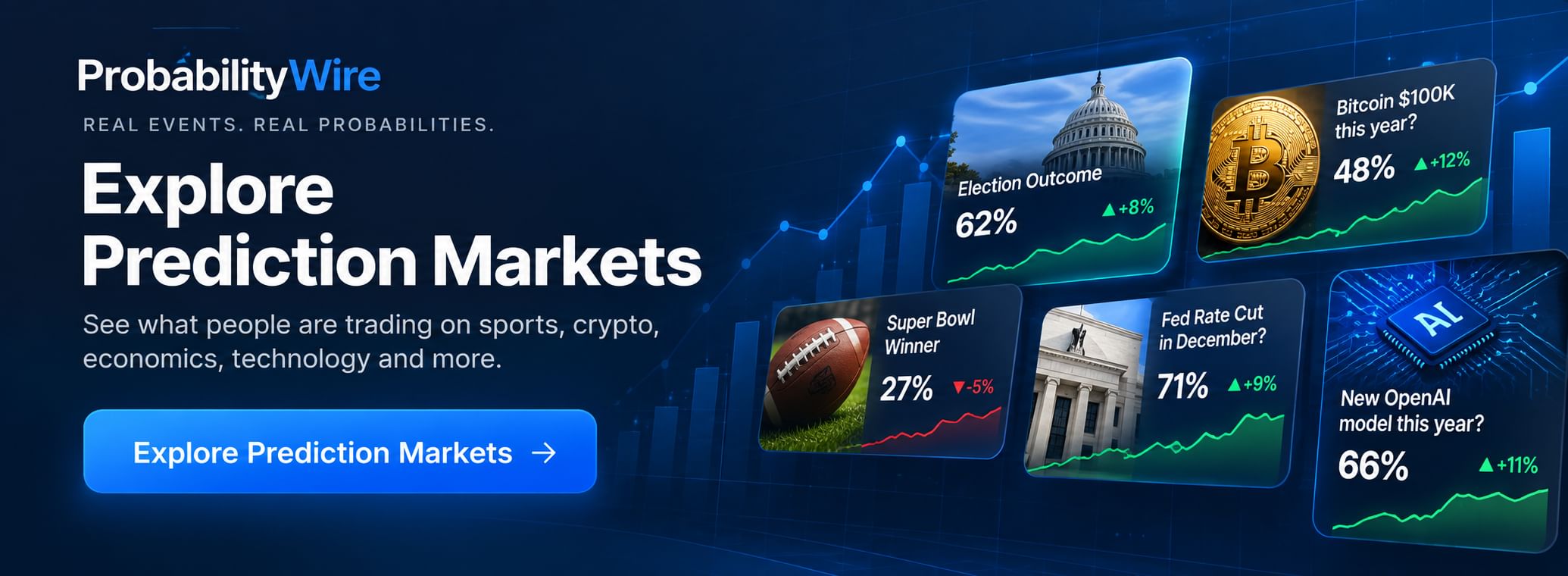
Technology Prediction Markets
Technology prediction markets are tradable markets where the “price” of a YES or NO contract reflects the crowd’s best real-time estimate of how likely a tech outcome is to happen by a stated deadline. People use them to hedge risk, test narratives, and aggregate information about everything from product launches and platform policies to crypto protocol upgrades and major security incidents. The key idea is simple: the market-implied probability can move as new information arrives and traders act on it, and it is not a guaranteed forecast.
What counts as a “technology prediction market,” and why people use them
In practice, “technology prediction markets” is a broad bucket. It can include markets about:
- Big Tech business events (acquisitions, executive changes, earnings milestones when structured as an event contract, and regulatory rulings that affect a company)
- Product and platform outcomes (feature releases, policy reversals, device launch windows, major app approvals, and subscription price changes)
- Cybersecurity and outages (breach disclosures, vulnerability patch timelines, service uptime incidents, and ransomware impacts when the resolution criteria are objective)
- Crypto and protocol events (hard forks, network upgrades, exchange-traded fund approvals, and stablecoin depegs that have clear measurement rules)
People tend to come for three reasons. First, markets offer a single number that updates continuously as beliefs change. Second, they can reveal disagreement - if the order book is deep and active - in a way that a headline or a poll cannot. Third, they give participants “skin in the game,” which can reduce the incentive to casually repeat a popular narrative.
How YES and NO contracts translate into implied probability
Most event contracts are binary: either the event happens by the deadline (YES) or it does not (NO). If a YES share pays out $1.00 when the event happens and $0.00 when it does not, then a traded price of $0.62 implies roughly a 62% market-implied probability.
That probability is not a promise. It is a snapshot of what traders collectively think, weighted by who is willing to buy or sell at that price right now. When a credible leak drops, a court filing posts, a blockchain exploit occurs, or a company issues guidance, the price can adjust in minutes.
The part many readers miss: resolution rules matter more than the headline
Technology questions are often messy, so the best tech markets are the ones with unusually crisp resolution criteria. Before treating a price like useful information, check:
- The exact cutoff time and time zone for the outcome
- The primary source(s) used for resolution (court docket, company press release, regulator website, blockchain data provider, and so on)
- How edge cases are handled (partial outages, delayed announcements, renamed products, reorgs on a chain, or “soft launches”)
If you have ever argued about whether something “counts” as a feature release, you already understand the main risk. A market can be perfectly liquid and still be a poor measurement tool if the resolution standard is ambiguous.
What kinds of tech questions actually work well as event contracts
Tech prediction markets work best when the event can be verified cleanly by an independent source. Examples that tend to be structurally strong include:
A regulatory decision posted by a specific agency by a specific date. A company announcing a named product by a stated deadline. A blockchain reaching a defined upgrade condition that can be verified on-chain.
By contrast, markets tied to subjective language (“major breakthrough,” “widely adopted,” “significant outage”) are harder to resolve fairly. Those can still exist, but they put more weight on the platform’s rules and the resolver’s judgment.
For readers who want a deeper primer on how event contracts are structured, ProbabilityWire’s guide on prediction markets is the natural starting point.
Trading mechanics that shape tech-market prices in the real world
Even when a question is well-written, the “probability” you see is influenced by microstructure - the nuts and bolts of how trading happens.
Liquidity and trading volume matter because they determine how expensive it is to change the market’s mind. In a thin market, one motivated trader can move the implied probability a lot. In a thick market, big swings usually require either major news or sustained buying and selling pressure.
Most platforms support some combination of market orders and limit orders:
- A market order prioritizes speed. You accept the best available prices, which can be costly in thin books.
- A limit order prioritizes price. You choose the price you want, but you might not get filled.
For tech markets around fast-moving stories (a zero-day exploit, an injunction, a surprise product leak), limit orders can reduce slippage, but they can also leave you on the sidelines while the price runs away.
“Is this just a poll?” Not really - and that difference shows up in tech topics
Polls measure opinions. Prediction markets measure opinions plus incentives, plus access to information, plus constraints like capital, fees, and risk tolerance. That difference matters in technology because information is often asymmetric.
A poll about “Will a company ship feature X this year?” mostly reflects vibe and media coverage. A market on the same question can incorporate supply chain chatter, developer signals, regulatory calendars, and the track records of specific teams - but only if traders with that information are willing and able to participate.
Traditional financial markets overlap with tech prediction markets too, but they are not the same instrument. Stocks price a bundle of expectations about future cash flows and risk. A tech event contract isolates one outcome, which can be useful when the underlying company is diversified or when the event’s impact on earnings is unclear.
Fees, spreads, and other costs that can quietly change your edge
Technology markets can look “easy” when the news cycle feels predictable. Costs are often what turn a seemingly smart trade into a mediocre one.
The big frictions to watch are:
- Bid-ask spread (the gap between the best buy and sell prices), especially in niche tech questions
- Trading fees and settlement fees, which vary by platform and can change how attractive short-term trades are
- Funding and withdrawal costs, including payment rails, processing times, and any minimums
Because fee schedules and funding options are platform-specific and can change, the safest habit is to confirm them directly on the platform before assuming your strategy will work the way it does on another venue.
Availability and regulation: why tech markets can differ by location and topic
Prediction markets and event contracts operate under different legal frameworks depending on where the user lives and how the platform is structured. Some platforms restrict access by geography, limit who can trade, or avoid certain categories of questions.
Technology topics can also collide with special sensitivities:
- Markets that resemble trading on material nonpublic information can raise uncomfortable questions, even if they are not securities.
- Markets about hacks, exploits, or security incidents can create perverse incentives if they are not designed carefully.
- Markets involving elections, policy, or geopolitical conflict can trigger additional restrictions.
If you want a broader sense of how regulation intersects with event contracts, ProbabilityWire’s coverage of event contracts provides useful context.
Settlement and disputes: what happens after the deadline passes
After expiration, the platform resolves the market based on its published rules and sources. If YES is correct, YES contracts settle at the full payout amount and NO settles at zero, or vice versa. Some platforms also support early settlement in rare cases when an outcome becomes certain under the resolution rules, but whether that exists depends on the venue.
Disputes tend to cluster around tech’s messy edges: a delayed launch that happens minutes after the cutoff, a security incident that is reported but later recharacterized, or a “release” that is staged. When you are evaluating a market, it is worth reading the platform’s dispute process and how it handles corrections, retractions, and source updates.
Practical ways traders use tech prediction markets (without pretending they are crystal balls)
The most common use is as a decision-support signal. For example:
- A product team might monitor markets related to competitor launches or regulatory decisions as one input among many.
- A founder might watch markets on funding conditions, such as rate decisions or recession risks, alongside traditional indicators.
- Crypto participants often use markets to track the implied odds of protocol upgrades, exchange approvals, or legal outcomes that can affect token ecosystems.
This overlaps heavily with crypto and macro topics, which is why readers often bounce between tech, economics, and digital assets. If that is your lane, ProbabilityWire’s crypto prediction markets coverage is a logical next read.
The biggest limitations to keep in mind before you trust a “probability”
Three issues explain most of the times tech prediction markets disappoint:
Badly defined questions. If “what counts” is unclear, the price is less informative because traders are pricing both the event and the ambiguity. Thin liquidity. A market can be more “movable” than “wise,” especially in niche technology storylines. Narrative gravity. When a storyline dominates social media, prices can track sentiment more than evidence, at least until hard proof arrives.
Used well, technology prediction markets can be a sharp tool for tracking uncertainty around launches, regulation, security, and crypto infrastructure. The best approach is to treat the price as a living estimate, verify the resolution rules, and pay attention to liquidity before you treat any implied probability as actionable information.